Field Notes
The Neuroscience of Nighttime Anxiety
Nighttime Anxiety: The Neuroscience of What-Ifs
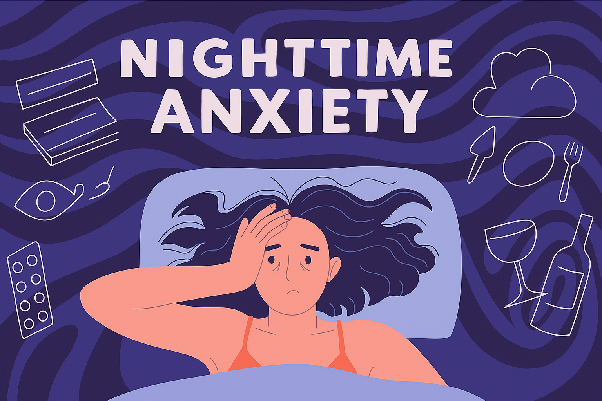
Let’s face it. Most of us have felt anxious at some point in our lives. Even the numbers agree. According to Gallup’s 2024 global survey, nearly four in ten adults said they had experienced anxiety attacks on occasion, most of them within the past day.1 Anxiety is an umbrella term for negative emotions linked to our perception of threat. Although it stinks, there is a reason why it lingers. From an anthropological perspective, anxiety is an essential feature of survival. It conditions our bodies to stay alert, focused, and prepared to respond to stressful situations.
During the day, we carry just enough anxiety to stay sharp. Our minds stay busy, pushing worries to the background and drowning them out with the noise of productivity. But when the night falls and the world grows quiet, our minds, like an empty stomach, turn into the loudest thing in the room.
Even comedian Wanda Sykes had something to say about that:
All jokes aside, when it comes time to wind down, anxiety can make going to sleep or staying asleep feel like an uphill battle. The drama continues throughout the night: tossing and turning at 3 a.m., wrestling with our blankets, and negotiating with our brain for “just five minutes” of peace. The worst part? Pretending to be alive at work the next day. The fatigue only worsens our stress, which heightens our anxiety, and then goes the downward spiral where our life quality is always the first and last casualty. Thankfully, we have the internet to understand the causes of nighttime anxiety and find reliable ways to take constructive action. But while countless articles explain how to cope, few explain why anxiety feels so much worse after dark. In this article, we’ll take a look under the hood of the anxious mind to uncover what happens in the brain when night falls.
The Science behind Nighttime Anxiety
The brain is an intricate organ laced with interdependent, dynamic networks that work in synergy to regulate conscious and unconscious processes. To understand why anxiety so often visits us at night, we can trace it through four key systems of the brain and body.
Circadian Rhythm: A Clock That Governs More Than Sleep
Our circadian rhythm is our body’s 24-hour biological clock. It keeps our bodies operating on a healthy sleep-wake cycle, telling us when to wake and sleep. But its influence doesn’t stretch far beyond sleep. Scientists now believe the circadian rhythm choreographs almost every biological process, from hormone release to immune function.2,3 Among its most important roles is the regulation of cortisol, the body’s primary stress hormone. Cortisol sharpens alertness and mobilizes energy by raising blood pressure, heart rate, and blood sugar. Under healthy conditions, cortisol peaks in the morning as we prepare to face the day, and dips in the evening to allow rest. But this rhythm is sensitive to psychological stress. Persistent worry, late-night rumination, or irregular sleep patterns can disrupt the cycle, keeping cortisol elevated well past sundown. The result is a body primed for survival at precisely the time it should be winding down, thus contributing to anxiety at night.
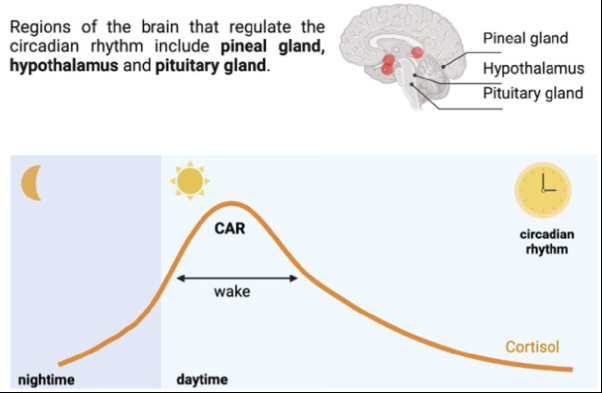
Cortisol rises rapidly after waking, peaks during the early daytime, and gradually declines, reaching its lowest levels at night (adapted from Andreadi et al., 2025).
The Ascending Reticular Activating System: Unconscious Vigilance
Even as the brain slows, our sensitivity to danger actually heightens thanks to the ascending reticular activating system (ARAS).4 The ARAS is the gatekeeper of arousal, responsible for keeping us awake, alert, and responsive to our surroundings. Even as other neural circuits power down, this system keeps a faint current of awareness running through the cortex, ensuring that a sudden sound or shift in the environment can bring us instantly to attention.5 From an evolutionary perspective, this low-level vigilance was crucial for survival. Prehistoric humans lived in a wild world tamed with predators and unpredictable dangers, so their minds have evolved to be attuned to cues of safety and threat. As their descendants, we inherited the same wiring. We still check the locks, pull the blanket tight, and listen for faint noises in the dark as we go to bed, to ensure that we are safe because sleeping makes us vulnerable. When contemporary stressors—loneliness, uncertainty, or unresolved conflict—activate this system, the ARAS interprets them as signs of danger. Instead of allowing the cortex to rest, it keeps a faint current of activity running through it, preventing the mind from fully shutting down.
The Amygdala: The Brain’s Smoke Detector
The amygdala is an important mediator of emotions, fearful memories, and stress on arousal and sleep. It maintains a bidirectional line of communication with the frontal cortex, the brain’s command center of willpower and restraints.6 Throughout the day, the frontal cortex reigns supreme over the amygdala, keeping its emotional surges in check to maintain a healthy balance. However, as the frontal cortex powers down for the night, its capacity to regulate the amygdala dwindles. The same loss of executive control that allows us to drift into dreams also leaves us more vulnerable to intrusive thoughts.7 All of a sudden, what felt manageable during the day feels threatening once the brain’s internal guard lowers.
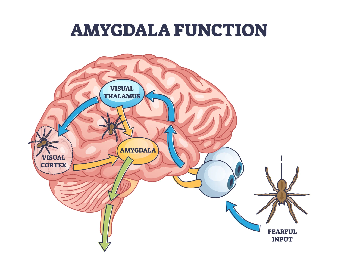
The amygdala processes a threat before the conscious brain does via a shortcut from the visual thalamus (adapted from Cherry, Kendra. “Amygdala Function Diagram,” Simply Psychology).
The Default Network: A Mind Turned Inward
In addition to the amygdala, another network that also increases in activity is the default mode network (DMN). This interconnected set of brain regions activates when our minds wander or turn inward, supporting self-reflection and memory consolidation. But in the absence of daytime distractions, the DMN can slip from reflection into rumination.8 We replay conversations, reimagine mistakes, and anticipate tomorrow’s problems. In anxious individuals, that inward turn can mean spiraling into fear or overthinking, keeping the mind awake long after the body is ready to rest.
BONUS: Evidence-based Tips to Calm Nighttime Anxiety
Understanding why anxiety rises at night is only half the work; the other half is teaching the brain to rest. Neuroscience offers practical ways to quiet the circuits that keep us awake.
1. Anchor your circadian rhythm: A stable sleep–wake schedule helps reset cortisol’s natural rise and fall. Going to bed and waking up at the same time (yes, even on weekends) reinforces the brain’s internal clock. Morning sunlight exposure (10–15 minutes within the first hour of waking) synchronizes the suprachiasmatic nucleus, the master pacemaker of circadian rhythm, which in turn stabilizes melatonin and cortisol release throughout the day.
2. Engage the parasympathetic system through breath: Slow breathing lowers amygdala reactivity and activates the vagus nerve, which slows the heart and shifts the body into a parasympathetic “rest and digest” state. Evidence supports the 4-7-8 pattern—inhale for four seconds, hold for seven, exhale for eight—as a simple, physiological brake on anxiety.
3. Limit rumination by redirecting the Default Mode Network: When the default mode network (DMN) spirals into overactivity, grounding the mind in sensory or cognitive tasks can help. Practices such as body scans, gentle stretching, journaling, or naming five things you can see, four you can touch, three you can hear, two you can smell, and one you can taste all work by anchoring attention to the present and reducing DMN-driven self-talk.
4. Avoid alcohol and late caffeine: Both substances interfere with GABA and adenosine, neurotransmitters that promote deep sleep. Even small doses can fragment sleep cycles and intensify nocturnal awakenings associated with anxiety.
5. Practice cognitive unloading: Research shows that writing down tomorrow’s to-do list before bed shortens sleep onset latency. This act of “externalizing” tasks relieves the frontal cortex from carrying them into sleep, allowing it to disengage without triggering the amygdala’s alert system.

Source: Bloomington Meadows Hospital
Final Thoughts: Teaching The Brain to Trust The Night
Nighttime anxiety isn’t a flaw in the human mind. If anything, it’s a byproduct of a system built to protect us. From the circadian rhythm that governs our sleep-wake cycle, to the ascending reticular activating system that keeps us alert, to the amygdala and default mode network that guard against danger and reflect on the past, each circuit plays its part in a centuries-old choreography of survival. What once kept our ancestors alive in the dark now keeps many of us awake in it. The challenge lies in reminding that ancient system that the night no longer needs defending. Through consistent routines, mindful breathing, and meditation that ground us in the present, we can gradually retrain those circuits to “slow down.” In doing so, we don’t just fall asleep faster; we learn to meet the dark not with fear, but with trust.
References:
- https://news.gallup.com/poll/695963/tracking-world-emotional-health.aspx
- https://www.nature.com/articles/nrg.2016.150
- https://genomemedicine.biomedcentral.com/articles/10.1186/s13073-019-0704-0
- https://pubmed.ncbi.nlm.nih.gov/18421835/
- https://journals.physiology.org/doi/full/10.1152/physrev.00032.2011
- https://www.imrpress.com/journal/JIN/21/6/10.31083/j.jin2106163
- https://pubmed.ncbi.nlm.nih.gov/33552705/
- https://pubmed.ncbi.nlm.nih.gov/37261927/